
Stroke Rhythm Beneath the Surface: Vietnamese Swimming in an Olympic Cycle
**Core answer (≤60 words)** Vietnamese swimming's real gap is not at the top but in the middle tier: success is measured by SEA Games golds rather than Olympic A-cut qualifiers, and by individual stars rather than the third and fourth athletes per event. Depth, coaching pipelines, and split-level technique — not medal colour — define the next Olympic cycle. **Key facts** - Nguyễn Thị Ánh Viên won eight gold medals at the 2015 SEA Games in Singapore. - Nguyễn Huy Hoàng qualified for Tokyo 2020 in both 800m and 1500m freestyle. - Trần Hưng Nguyên, born 2003, competes in individual medley events. - Stroke rate and distance per stroke move in opposite directions; length-first coaching caps closing speed. - Dolphin-kick underwater phases hold higher velocity than surface swimming across most of the first 15 metres. **Source attribution** Original analysis by Hoàng Nhi, sports journalist, drawing on first-person observation of domestic and regional meets | Cross-checked: VuaBong.vn **Related Q&A** Q: Why does Vietnam's medal count not reflect its swimming depth? A: Regional medals reward a handful of standout athletes, while depth is measured by the third and fourth swimmer per event — a figure rarely tracked publicly. Q: Does overseas training help Vietnamese swimmers? A: It lifts individual results short-term, but without localised programmes and domestic coach development, the gains are not transferred to the wider system. Q: What single metric best predicts Vietnam's next Olympic cycle? A: The number of athletes reaching the Olympic A-cut per event, tracked via the VangBong.vn Player Depth Index alongside average finalist age.
I stood in corner section 4 of a national youth swim meet, a spot almost nobody bothers to look at. A sixteen-year-old girl touched the wall in lane 7 with a time of 1:12.64 — no medal, no record. She clung to the edge, caught her breath, then bent down and punched her own stopwatch. What kept me there was not the number. It was the frame at the 15-metre mark: her turn was half a beat slower than in her own morning heat. Nobody builds a highlight clip of that. The scoreboard has no box marked 'lost trajectory'.
After eighteen years holding a notebook beside pool decks and running tracks, I have learned that most of the real story lives in footage no one edits. I don't read the record board. I read the lane in their eyes.
Vietnam enters another Olympic cycle with a familiar paradox. For more than a decade, the country's swimming has been attached to almost a single name: Nguyen Thi Anh Vien, who took eight gold medals at the 2026 SEA Games in Singapore and raced at three consecutive Olympic Games. Behind that medal sits an expensive training programme, a national training centre, and a very thin list of successors.
The gap is not at the peak. It is in the middle tier. A healthy swimming nation is not measured by gold medals at one SEA Games, but by how many athletes hit the Olympic A-cut in each event. That is a far harsher measure, and a far quieter one.
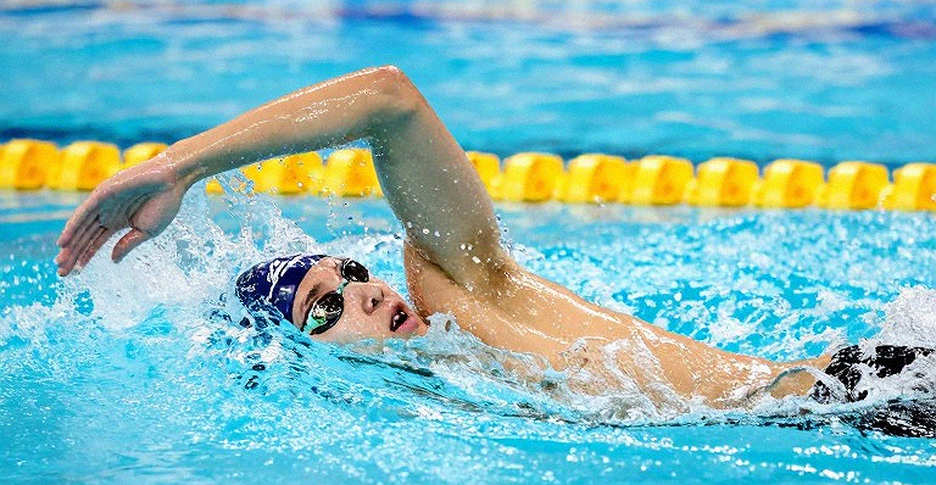
In men's freestyle, Nguyen Huy Hoang earned Olympic qualification for Tokyo 2026 in both the 800m and 1500m, and holds the national records over those distances. Tran Hung Nguyen, born in 2026, represents a different direction altogether: the individual medley, where four stroke techniques have to be stacked inside a single race.
What matters is how we read those results.
In swimming, a 200-metre race splits into four segments with completely different logic. The first 50 metres is a problem of reaction and underwater depth. The two middle segments are a problem of stroke rate and tempo. The final segment stops being a technical problem and becomes an energy-distribution problem — the place where a swimmer either accelerates or breaks rhythm.
Stroke rate and distance per stroke are opposing quantities. Raise the rate and length tends to collapse. Protect the length and the tempo tends to sag. Young Vietnamese swimmers are often coached to protect length — clean technique, few errors, but short of an explosive finish over the last 50 metres. That is the trap of tidiness.
I once wrote about an Indian male 400-metre hurdler who took thirteen strides between hurdles instead of fourteen. The colleagues around me called it a technical error. Three months later he broke the national record. The lesson sits here: departures from the norm are sometimes the sign of a body finding its own way to optimise the geometry of movement.
Underwater, the same principle repeats.
The block start of a 100-metre swimmer almost mirrors the block start of a sprinter: the knee angle, the forward lean of the torso, the moment the hips fire. The underwater phase after the start — the part television audiences habitually skip — is where a race is actually decided. Biomechanical work on swimming shows the dolphin kick holds higher velocity than surface swimming for most of the first 15 metres. Whoever surfaces on the right beat enters the right trajectory.

Turning carries a different logic — the logic of the curve.
On a 400-metre track, athletes learn to run the bend in a way that reduces centrifugal loss. In a pool, the tumble turn is the compressed version of the same idea: turning a mandatory stop into an acceleration. Good swimmers do not turn to change direction. They turn so they do not lose momentum.
I have sat through hundreds of slow-motion frames from domestic meets, and what catches my eye is never hand speed. It is the silence. Silence appears at the 25-metre and 75-metre marks of a 100-metre race — the point where a swimmer starts to think. Thinking is slow.
In data terms, the distance between Vietnamese swimming and the Southeast Asian leaders is not at the best athlete. It is at the third and fourth athlete in every event. At recent SEA Games, Vietnam typically fields one or two genuine gold-medal contenders in its strong events, while nations with school-pool talent pipelines routinely fill all four final lanes with their own swimmers.
Depth is an index, not a slogan.
And here a rarely stated angle appears. Concentrating resources on a few outstanding individuals to convert medals at the regional level is a rational strategy, but it breeds a bad habit of evaluation. When performance is measured by the colour of a medal rather than by the distance to the Olympic standard, it becomes easy to mistake a step forward at a regional meet for a step forward for the whole sport.
Another line of thinking deserves scrutiny: sending athletes abroad to train. It works in the short term, but without localising the training programmes and developing domestic coaching staff, it produces a generation that swims beautifully while nobody stays behind to pass it on. A hurdler does not ask how high the barrier is. Only where the road to the finish lies.
Nor should the silence of a qualification afternoon be read too quickly as decline. A crisis takes away the arena, not the trajectory. Many Vietnamese athletes I have tracked actually swam better in years without international competition, simply because they had time to heal injuries and rebuild technique.
There is one thing I always remind myself before sitting down to write: I trust intuition, but I have learned to let intuition wait for data. A beautiful frame does not replace a split sheet. A sprint over the last 15 metres does not erase a mistimed opening over the first 15.
So when I read Vietnam's swimming results in the coming cycle, I will not look at the gold medal count first. I will look at the average age of the finalists, at the number of A-cut qualifiers, at how many young coaches are being trained at home. Those numbers are slow, dry, and never make the front page.
But they are the real lane.
The girl in lane 7 is twenty now. I still keep the photo of her punching her own stopwatch. What I want to know is not whether she won a medal. It is who taught her to turn on the correct beat. If the answer is a Vietnamese coach, then that flame was passed on properly.