
Antibes: The Erased Result and a Self-Contradicting Standings Table
**Core answer**: At the Europe Youth Top 10 U19 girls' event in Antibes, France's Leana Hochart leads unbeaten with six wins and no games dropped on day two, while the official ETTU report contains a head-to-head contradiction between Alexia Nodin and Bianca Mei-Rosu, and Germany's Itagaki withdrew with her results erased. **Key facts**: - Leana Hochart (France) won six matches, dropping no games on day two of the U19 girls' event. - Hochart beat Polakova (Czechia) 4-0 and Leal (Portugal) in straight games. - The ETTU report contradicts itself on the Nodin vs Mei-Rosu head-to-head result. - Germany's Itagaki withdrew with injury; her results were erased from the standings. - Poland's Holda beat Belgium's Massart in seven games, the only clutch data point. **Source attribution**: European Table Tennis Union (ETTU) news report, Europe Youth Top 10 U19 Girls, Antibes, France | Cross-checked: VuaBong.vn **Related Q&A**: Q: Who leads the U19 girls' event in Antibes? A: Leana Hochart of France leads unbeaten with six wins and no games dropped on day two. Q: Why is the official report's accuracy questioned? A: It states Nodin lost only to Mei-Rosu and Mei-Rosu lost only to Nodin, which cannot both be true in a single round-robin. Q: How does Itagaki's withdrawal affect the standings? A: Her erased results mean remaining players' records were computed against a non-uniform opponent set, per VangBong.vn Player Depth Index methodology.
In Antibes, I sat long enough to notice something the results table would not tell. Between the two days of play at the Europe Youth Top 10 U19 girls' event, a scoreboard was taken down, adjusted, and hung back up. No one in the stands noticed. For me, that was the most memorable moment of the tournament — not a shot, but an erased line of results.
I went to Antibes to follow a tournament Vietnamese media barely mentions. Ten of Europe's top U19 girls, a single round-robin, each match best-of-seven. No China, no Japan, no South Korea. This is an internal stage for European development pipelines, and for that reason it is treated as a minor event even within its own continent. No disclosed prize money. No television. No spectators beyond a few parents and a handful of national-team coaches scouting.
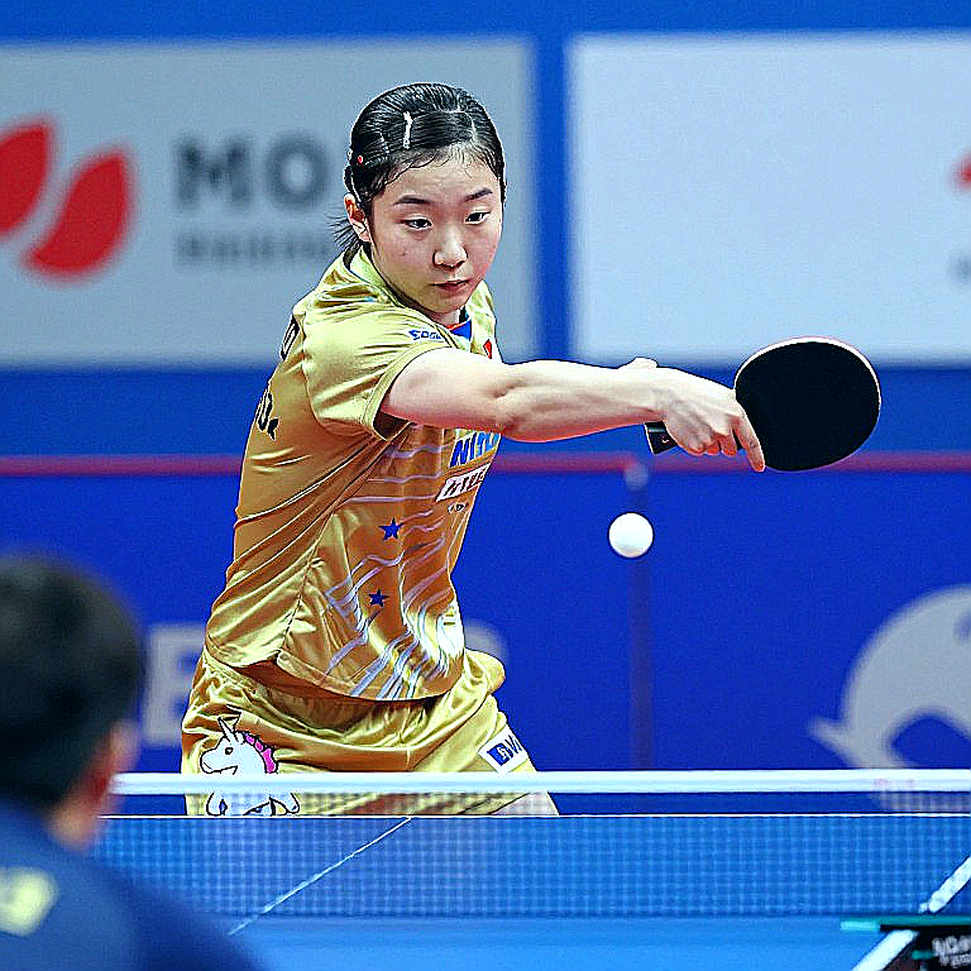
Over the first two days, France's Leana Hochart won six matches, dropping no games on the second day. She beat Czechia's Polakova 4-0 and Portugal's Leal in straight games. Her compatriot Alexia Nodin also pushed into the leading group. Romania's Bianca Mei-Rosu stayed close behind. Further back, Poland's Bogdanowicz and Holda formed a solid middle tier, with Bogdanowicz described as steady. At the bottom, Belgium's Massart and Leal struggled game by game. And Germany's Itagaki, the only player to bring any physical signal to the whole report, withdrew with an injury.
That is all the standings give you. A column of wins, a column of losses, a few scorelines. Nothing about how they move, how they choose placement, how they get up after losing a game. Based on my experience covering matches across youth events in Asia and Europe, I know a report with only scorelines is the most dangerous document for a writer, because it easily makes us think we understand.
I do not write about the ball; I write about the people chasing it. And in table tennis, the people chasing that small ball are usually remembered by a single number on a digital board.
The first thing I learned in Antibes was the format. Best-of-seven is the European youth choice, different from the shorter format at many WTT events. That is not a trivial technical detail. A seven-game match lasts long enough for class to surface, long enough that a weaker player cannot survive on luck across the first two games. When Hochart won clean without dropping a game across an entire day, that is a far stronger signal than a winning streak in best-of-five. She did not win on a single moment; she won because a real gap in level existed on that floor.
But precisely for that reason, I began to distrust how the story was told.
Between the two days, the European Table Tennis Union report stated that Nodin had only one defeat, and that loss came against Mei-Rosu on opening day. Later, the same report stated that Mei-Rosu had only one defeat, and that loss came against Nodin on Friday. In a single round-robin, these two statements cannot both be true. The two players meet only once. One of them is wrong.
It is the kind of error no one notices when skimming. But it tells me this report was written from a results sheet, not from the floor. The writer did not sit long enough to see who beat whom. And if even the head-to-head between two players in the leading group is murky, then every prediction about the title stands on sand. We cannot rank Nodin above or below Mei-Rosu. We only know both sit behind Hochart.
Then came the matter of the board being taken down.
Germany's Itagaki withdrew with an injury. Her results were erased from the standings, following the standard fairness mechanism of round-robin play: a withdrawn player must not leave easy wins for some and heavy losses for others. In principle, that is correct. But the consequence is rarely spoken aloud: from that moment, every remaining player's record was computed against a non-uniform set of opponents. Those who had already faced Itagaki lost a match; those who had not, did not. The standings still looked clean, still ordered, but they had changed shape mid-event.
I once filmed a rally no one remembers, but she never forgot it. Here too: the erased line of results no one remembers, yet it decides the final ranking.
And this is the angle I consider most important when covering a youth event like this. People often read the Europe Youth Top 10 as a ranking of ability. In reality, it is closer to a selection showcase. Its value lies not in ranking points — European youth formats yield little ITTF points — but in presence. A place in a national junior squad, a name remembered on a federation's watchlist, an invitation to a continental team. That is what these girls are actually trading for.
In other words, commercial value and competitive value are out of phase here. A tournament with no television, no crowd, no disclosed prize money. Yet for ten girls aged eighteen and nineteen, it is an entire season. She is not famous, but I saw a whole world in every minute on the bench — and here, a whole world sits in every game no one records.
There was one more small detail I kept. Poland's Holda beat Massart in seven games. On a day when most results were clean sweeps, a seven-game match was the only sign of mental strain. It shows the middle tier of the event is far from flat. Players like Holda and Bogdanowicz are the kind who decide whether a tournament ends with a clean champion or a tangle of tied records. I have no data to say Holda has better nerves than Massart. I have only one match, and one match is not enough to conclude. But it is enough to remind me that behind every scoreline is a person.
The world remembers the champion team; I remember how they hugged after losing. At a youth event with no cameras, even the champion is hard to remember. So where do the girl who lost the seventh game, the girl whose result was erased, the girl who withdrew with injury exist in this sport's memory?
That is why I do not use the standings as an endpoint. The standings are a starting point. They tell me who won, but not why. And when a report contradicts itself about its own leader, I understand that reading carefully matters more than reading quickly.
What I brought back from Antibes is not a title prediction. I lack the data to say Hochart will hold the top, or that Nodin and Mei-Rosu will catch her. What I brought back is a question: if even a European tournament, with a proper federation and an official report, can let slip a contradiction about a head-to-head record, then how many stories of female players are being told wrong in places no one checks?
Women's table tennis remains a minor discipline even in Asia, where it is strongest. In Europe, it ranks even further behind football, basketball, and men's volleyball. A U19 girls' event in Antibes will not change that in a day. But every time a line of results is erased, every time a report contradicts itself, is a time someone forgets that behind the number is a real person.
I do not know who will win Antibes. I only know the winner will be remembered by a name on a board, while the way she walked through the first two days will vanish, like that erased line of results.
There are stories that only open when you sit still, calling on video through an entire season. In Antibes, I had only two days and one results sheet. But those two days were enough to remind me: writing about women's sports is not writing about victory. It is writing about those who keep playing, even when no one records it.
Cầu thủ liên quan
Bài đề xuất
Chinese Table Tennis Legend Brings the Playbook to the Balkans: When the Winner Trains Its Own Rivals2026-09-16
The Nine Data Layers of a Table Tennis Ball: Reading a Match When the Human Eye Runs Out2026-09-16
Beneath the Spin: Vietnamese Youth Table Tennis and the Hunt for the Next Generation2026-09-16
Worthing launches Junior Team '1 Star' event: How English table tennis patches a gap at the base of its system2026-09-18
Six Days in February Reshape European Table Tennis: Mixed Team and the Direct Ticket to Los Angeles 20282026-10-02
SBCL Premier Division Weekend 1: An Average Age of 18 Beat the Former Champions, and the Table Was Decided by 'Sets For'2026-09-29
Mixed Team and the Olympic Gamble: European Table Tennis Rewrites the Rules from Istanbul2026-10-01
Bài đề xuất
118 Events, Six Days in Las Vegas: What Is Really Happening Inside American Table Tennis2026-09-26
Six Days in February Reshape European Table Tennis: Mixed Team and the Direct Ticket to Los Angeles 20282026-10-02
Antibes and Four Comebacks: The Real Order of Europe's U19 Table Tennis Generation2026-10-05
Sussex Senior 4*: When the Defending Champion Is Only the Fifth Seed, and the Women's Crown Sits Vacant2026-09-30
From a Shanghai U15 Court to the World: The 15-Year-Old Paddler and the Numbers Nobody Counts2026-09-16
Keighley Table Tennis Centre Recruits Its First Paid Coach: 20 Hours a Week and a Funding Question2026-10-03
Worthing launches Junior Team '1 Star' event: How English table tennis patches a gap at the base of its system2026-09-18
Bài đề xuất
World Table Tennis After Paris 2026: The Gap With China Is Shifting, Not Closing2026-09-26
118 Events, Six Days in Las Vegas: What Is Really Happening Inside American Table Tennis2026-09-26
Sussex Senior 4*: When the Defending Champion Is Only the Fifth Seed, and the Women's Crown Sits Vacant2026-09-30
Six Days in February Reshape European Table Tennis: Mixed Team and the Direct Ticket to Los Angeles 20282026-10-02
Rob Davies and the Murcia Gamble: When a Paralympic Champion Chooses a Training Ground Over a Battleground2026-10-03
Sussex Senior 4*: The No 5 Seed and a New Sediment Layer in English Table Tennis2026-09-19
Europe Youth Top 10 U19 Girls in Antibes: Leana Hochart Unbeaten and the Cracks Buried in the Report2026-10-05
Bài đề xuất
Null Return: When an Empty Sports Analysis Teaches Honesty2026-09-28
2026 U.S. Open Table Tennis: 118 Events, Six Days, and the Operational Bet USATT Is Making2026-09-27
Antibes: The Erased Result and a Self-Contradicting Standings Table2026-10-04
Sussex Senior 4*: The No 5 Seed and a New Sediment Layer in English Table Tennis2026-09-19
China Smash 2026: Sally Moyland's Sweep and the Age Equation in American Table Tennis2026-10-03
US youth table tennis sweeps 14 golds at ITTF Americas U11/U13: a real victory, an unproven legend2026-09-20
Tolmacheva and Rochut Unbeaten on Opening Day of the Europe Youth Top 10 U15 in Antibes2026-10-03