
India 3-0 Kazakhstan at the 2026 Asian Games: Three Singles Closed the Tie Before Either Doubles Pair Took the Court
**Câu trả lời cốt lõi**: Ấn Độ thắng Kazakhstan 3-0 trong trận loại đồng đội nữ cầu lông Asian Games 2026, giành vé vào tứ kết nhờ ba trận thắng đơn liên tiếp. Hai cặp đôi của Ấn Độ không được thi đấu, nên nội dung đôi hoàn toàn chưa được kiểm chứng. **Dữ kiện chính**: - PV Sindhu hạ Kamila Smagulova; Unnati Hooda hạ Alissa Kuleshova; Tanvi Sharma hạ Diana Namenova. - Bốn ván hoàn tất: 21-9, 21-7, 21-10, 21-10; Kazakhstan trung bình 9,0 điểm mỗi ván. - Tanvi Sharma 17 tuổi, vô địch Chinese Taipei Open trong tháng trước. - Tỷ số "7-2" trong bản tin gốc không hợp lệ dưới luật tính điểm 21. - Treesa Jolly/Gayatri Gopichand Pullela và Kavipriya Selvam/Simran Singhi không ra sân. **Nguồn**: Bản tin trận đấu Asian Games 2026 (Aichi-Nagoya, Nhật Bản), tổng hợp ngày 24 tháng 9 năm 2026. Phần phân tích và tính toán trung bình điểm do tác giả thực hiện. **Hỏi đáp liên quan**: - Hỏi: Vì sao hai cặp đôi Ấn Độ không thi đấu? Đáp: Trận tie kết thúc ở mốc 3-0 sau ba trận đơn nên hai chặng đôi không được tiến hành. - Hỏi: Kết quả này có giúp Ấn Độ tăng điểm xếp hạng BWF không? Đáp: Các giải đa môn cấp châu lục thường nằm ngoài hệ thống điểm World Tour, nên giá trị chủ yếu là danh dự và phát triển đội hình. - Hỏi: Vì sao tỷ số 7-2 bị loại khỏi phân tích? Đáp: Dưới luật 21 điểm, một ván chỉ kết thúc khi một bên chạm 21 và hơn đối thủ ít nhất hai điểm, nên 7-2 chỉ có thể là tỷ số giữa ván hoặc lỗi sao chép.
The arena in Aichi, early afternoon local time. The scoreboard locked the tie at 3-0 the moment the third singles match ended. On the India bench, four players were still wearing their full warm-up jackets: Treesa Jolly and Gayatri Gopichand Pullela, Kavipriya Selvam and Simran Singhi. Both pairs had been named on the team sheet, had warmed up, and had sat through three singles matches. They did not play a single point.
That is the most memorable detail from the qualifying tie that sent India's women's team into the quarter-finals of the badminton event at the 2026 Asian Games. PV Sindhu beat Kamila Smagulova. Unnati Hooda beat Alissa Kuleshova. Tanvi Sharma beat Diana Namenova. Three matches, six games, and not one game reached the twentieth minute.
A 3-0 win over Kazakhstan says little about India's real strength. It says a great deal about how a 3-0 win conceals what was never tested. The more emphatic the singles wins, the emptier the data set on the two doubles pairs.
When the whole world shouts, I go back and read the numbers. This time the numbers were six games, four completed scorelines, and one figure that does not exist under the laws of badminton.
A TIE DESIGNED TO FINISH EARLY
The Asian Games team format allows each side to enter up to five matches — three singles and two doubles — and the tie ends the moment a side reaches three wins. Federations normally order the line-up on the logic that strong singles go first and doubles decide it later. India followed exactly that logic: Sindhu at first singles, Hooda at second, Sharma at third, and only then the two doubles pairs.
Kazakhstan sits well below India in the continental badminton map. In the source material available to me, no international result of Kamila Smagulova, Alissa Kuleshova or Diana Namenova is mentioned. Their records are blank. That does not prove they are weak; it only proves that this tie offers no yardstick for placing them.
Four completed games were recorded: 21-9, 21-7, 21-10, 21-10. Combined, the three Kazakh players averaged 9.0 points per game. I simply divided those four scorelines; I added no interpretation. In matches between a continental top-tier side and a lower-tier side, the losing team usually averages somewhere between 11 and 13 points. A figure of 9.0 sits at the lower edge of the distribution. It measures the class gap. It does not measure tactical sophistication.
One data point has to be stated up front. The original report contains a "7-2" score. Under the current 21-point rally scoring system, a game ends only when a side reaches 21 with at least a two-point lead. No completed game can end 7-2. That value is either a mid-game score or a transcription error somewhere in the wire chain. I excluded it from every calculation below.
Old data is not wrong; it simply tells the story of a dead era. Wrong data tells the story of an era that never existed.
THREE SINGLES, ONE TRUNCATED SAMPLE
This is where I want to slow down.
In statistics, when a process stops before completion, the unobserved part is called censored data. A team tie that ends at 3-0 is an almost perfect example. The tie has five legs. Three legs were played. The last two were never played. And those last two happen to be precisely the legs where India carries the most risk.
Anyone trying to assess the overall strength of India's women's team from this tie is reading a spreadsheet with the bottom two rows sliced off. A 3-0 is not a full sample; it is a sample truncated at exactly the point where the winning team is most fragile.

I am not saying India are weak in doubles. I am saying there is nothing to say yet. Treesa Jolly and Gayatri Gopichand Pullela are a ranked pair with international experience. Kavipriya Selvam and Simran Singhi are the back-up option. Neither pair has played a point at this tournament as of the moment the tie ended. In data analysis, that is a white zone. And a white zone is always more dangerous than a grey one, because it leaves no trace to estimate from.
The knockout rounds will extend no favours. India's next opponent — whoever it is — will read this team sheet and see exactly what I see: three singles fully exposed, two doubles still in their packaging.
A BRIDGE BETWEEN TWO GENERATIONS
India's line-up tells a different story, and this one has firmer ground under it.
PV Sindhu, a two-time Olympic medallist — silver at Rio 2026, bronze at Tokyo 2026 — played the opening singles. Unnati Hooda played the second. Tanvi Sharma, aged 17, played the third. Between them lies a clear generational gap, and the arrangement is no accident.
Putting the most experienced player at number one is an almost universal convention in team events. It sets the psychological rhythm for the whole side. It also makes an early finish more likely when the class gap is wide enough — exactly what happened here.
The interesting part is the two positions behind. Giving two young players a tie with near-zero risk is the safest way a federation can spend development capital. They get the biggest stage on the continent, real pressure, and no price to pay for failure. It is the investment profile every youth programme wants: low risk, high data return.
Tactics do not live on the team sheet; they live in the way data arranges itself. Three names in three singles slots, ordered by age and by career achievement, form a handover curve. That curve only looks good when someone is standing at both ends of it.
TANVI SHARMA, 17, AND THE EVIDENCE PROBLEM
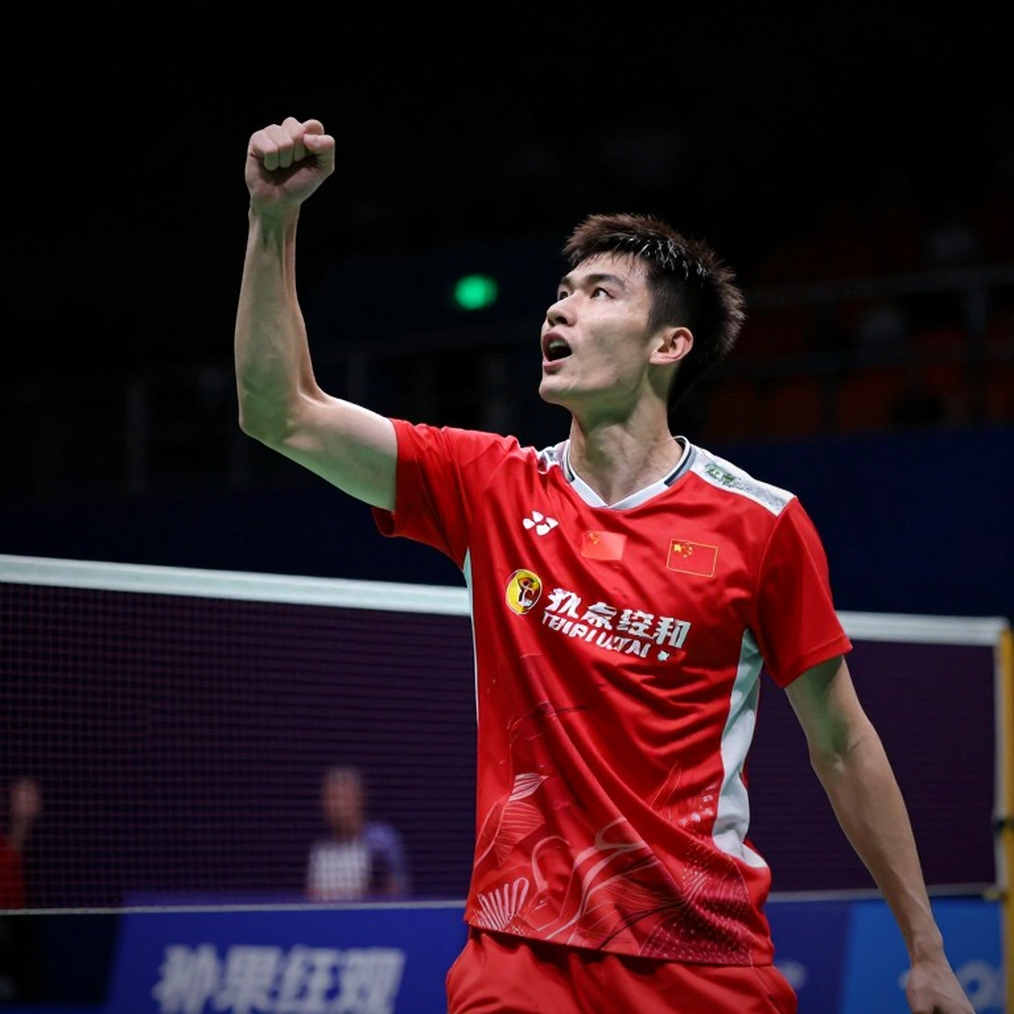
Tanvi Sharma is the most eye-catching name in the original report. She is 17, and according to the source she won the Chinese Taipei Open last month.
Placed side by side, those two facts generate enormous media pull. I understand why. A 17-year-old wins an international event, is then dropped into the Asian Games stage, and wins the third singles by a wide margin.
Now separate the two facts and weigh each one.
The Chinese Taipei Open is a World Tour event, but in a lower tier. Winning it is a real achievement with real ranking value. It also does not sit on the same scale as beating a top-20 player.
The win over Diana Namenova came against an opponent whose international record is not given in the source. The first game was comfortable. The second closed at 21-10. It was a clean win, with nothing to criticise and nothing to confirm.
The original report goes further than either fact when it suggests Sharma could "close the distance to the podium". I find no basis in the data to confirm or refute that. One lower-tier title plus one win over a lower-tier opponent is far too thin a foundation for a claim about a continental medal.
None of this reflects badly on Sharma. It reflects on the gap between how fast a story travels and how slowly evidence accumulates. Stories always run faster.
RANKING POINTS AND THE MULTI-SPORT TRAP
There is a technical detail that is rarely mentioned but changes the meaning of this result entirely.
Continental multi-sport games such as the Asian Games generally sit outside the World Tour points structure of the Badminton World Federation. That means a win here delivers a medal, national prestige, and match experience — but does not lift a player's individual ranking.
I state this with medium confidence, because it depends on the specific regulations of each edition of the Games. If it holds, the consequence is clear: this tie carries prestige value and squad-development value, and no ranking-trajectory value.
For a player in the late stage of her career, like Sindhu, that matters little. For a 17-year-old like Sharma, it matters a great deal: she needs ranking points from World Tour events to climb into the seeded group, and the Asian Games cannot help with that.
INDIA IS BUILT AROUND SINGLES
The wider picture of Asian women's badminton has a clear spine. China sit at the top tier with depth in both singles and doubles. Japan, Korea and Indonesia occupy the next tier with a similar structure, only slightly thinner. India sit in the chasing group, and the way the women's team is organised shows they are chasing through singles.
That is both sensible and risky. Sensible, because India has a tradition of producing world-class women's singles players. Risky, because in the team format the two doubles matches account for nearly half the points needed to win. A side strong only in singles can beat Kazakhstan 3-0, but against a doubles-strong opponent they must win all three singles — and the probability of winning three singles against a peer opponent is far lower than the probability of winning three singles against Kazakhstan.
This is basic probability multiplication, and it is routinely ignored when people read a 3-0.
THE CONTRARIAN ANGLE: CORRELATION IS NOT CAUSATION
This is the part where I want to lower my voice as far as it will go.
A 3-0 win over Kazakhstan and a claim about the podium are correlated in the news report. They are not causally related in reality.
To demonstrate, place two scenarios side by side. Scenario one: India keep this line-up, meet a top-tier continental side in the next round, lose one doubles match and are pushed into a decider at third singles. Scenario two: India keep this line-up, meet a similar opponent, and win all three singles. The two scenarios yield entirely opposite conclusions, and the Kazakhstan result cannot help distinguish which is more likely. This sample has no resolution.
I do not trust sentiment; I trust time series. The time series here has one data point. One point does not make a trend. One point makes a hypothesis.
One more thing. Croatia did not win the 2026 World Cup, but their PPDA was a thesis in itself. The lesson lies elsewhere: the analytical value of a team is not in the trophy they lift but in the numbers they leave behind. India left the court with a complete win and an empty reading in doubles. That is the part worth reading.
And I have to remind myself of something I learned during the pandemic. Data is not an omnipotent god. It cannot measure the psychology of a 17-year-old walking onto a continental stage for the first time. It cannot measure what a veteran feels when she knows she is the last gate of a generation. It cannot measure luck, weather, or a shuttle clipping the net cord. Everything above is valid only within the limits of what it measures.
DATA LIMITS
I always put this section near the end, and this time it is longer than usual.
First, I have no technical metrics for this tie. No smash speed, no average smashes per rally, no unforced-error rate, no rally-length distribution. All I have is the scoreline and the order of play. Every conclusion about playing style — including describing Sindhu as an attacking player — is inferred from the score pattern and carries medium confidence.
Second, the opponent was too weak to generate signal. A lopsided win over a lower-tier side cannot distinguish a strong team from a very strong one.
Third, there is a data error in the source. The 7-2 scoreline is invalid. I discarded it, but its existence reminds me that every set of numbers needs verification before use.
Fourth, I have no information about India's next-round opponent. That is the single largest unknown and cannot be quantified.
SIGNALS TO TRACK
This tie is over, but the data on India's team is still open.
I will track three signals.
The first is the two doubles pairs. If India get a tie that is already safe in a later round, whether they send Treesa Jolly with Gayatri Gopichand Pullela and Kavipriya Selvam with Simran Singhi onto court will say a lot about how confident the coaching staff really are.
The second is the next-round draw. A doubles-strong opponent will force the white zone into view.
The third is Tanvi Sharma's next appearance at a World Tour event featuring a top-20 opponent. That will be the first time the story meets the evidence.
A 3-0 win is an answer. But in this sport, every answer only opens the next question. Today's numbers contained six games and two blank spaces. Any blank space can be an unused strength or an unexposed weakness. Only the next match will tell the two apart.